
The Arizona Telemedicine Program Blog, Category: Technology

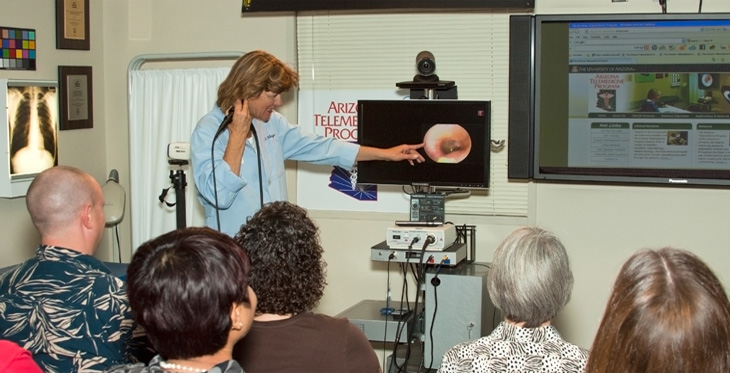
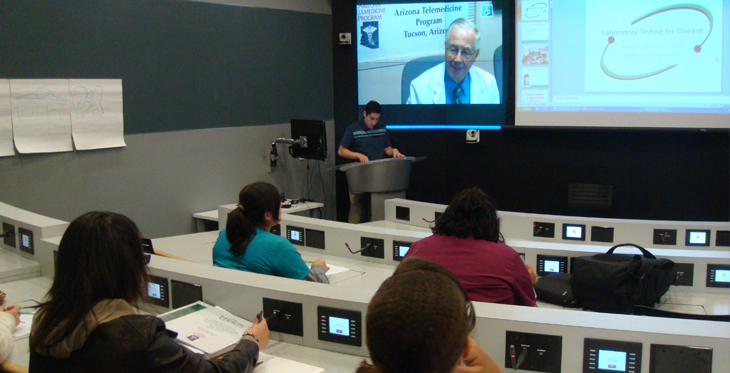
Arizona Telemedicine Program's T-Health Institute opened in 2003 on the University of Arizona's Biomedical Campus in downtown Phoenix. Its mission: to offer telemedicine and telehealth training, and to serve as a prototype e-classroom of the future.

The Institute is fulfilling its mission. More than 20 different organizations have used the amphitheater over the past 12 months, and not all are about medicine and health care.

In 2006, Banner Health made the decision to equip every one of their ICU beds with an eICU system that provides round-the-clock, “remote” care to critical care patients. Banner Telehealth’s eICU operations centers, located in Mesa, Ariz., Denver, Colo., Santa Monica, Calif., and Tel Aviv, Israel, has helped reduce patient mortality and shortened ICU stays.

In 2013, Banner took another step toward state-of-the-art intensive care, by implementing a tele-echocardiography system to relay patients’ echocardiographic images to the eICU in real time. This was achieved by training respiratory therapists to obtain the images and project them in real time to the tele-ICU physician via the tele-ICU Camera.

Internet and Wirelessly Connected Medical Devices (“Devices”) are a cybersecurity concern of the Food and Drug Administration (FDA) as evidenced by guidance it issued in October 2014. The FDA Guidance does not have the force of law—but is highly influential in the medical device industry. Likely, failure of compliance will delay or prevent FDA approvals of such Devices.

The boy's eyes are captivated by the voice of the woman in the white starched coat. She seems to be speaking directly to them from the television screen. His mother's face relaxes for the first time in weeks as she holds him and repeats in a soft voice as if to convince herself, "The quarantine is over."

***

Although not a current reality, medicine has entered the digital age, and this scene may be tomorrow's reality.

Did you know that there are more than 75,000 health care professionals on Twitter? That 41 percent of consumers are using Facebook, Twitter, YouTube and online forums to select health care providers? Or that social media can help track the spread of fast-moving illnesses like influenza?

When you think of social media in health care, you might think it’s all about marketing. But experts agree, it goes beyond that.

Farris Timimi, medical director for the Mayo Clinic Center for Social Media, said that social media in health care is a "moral obligation.”